
If you prefer to listen to this post, an audio version is available here…
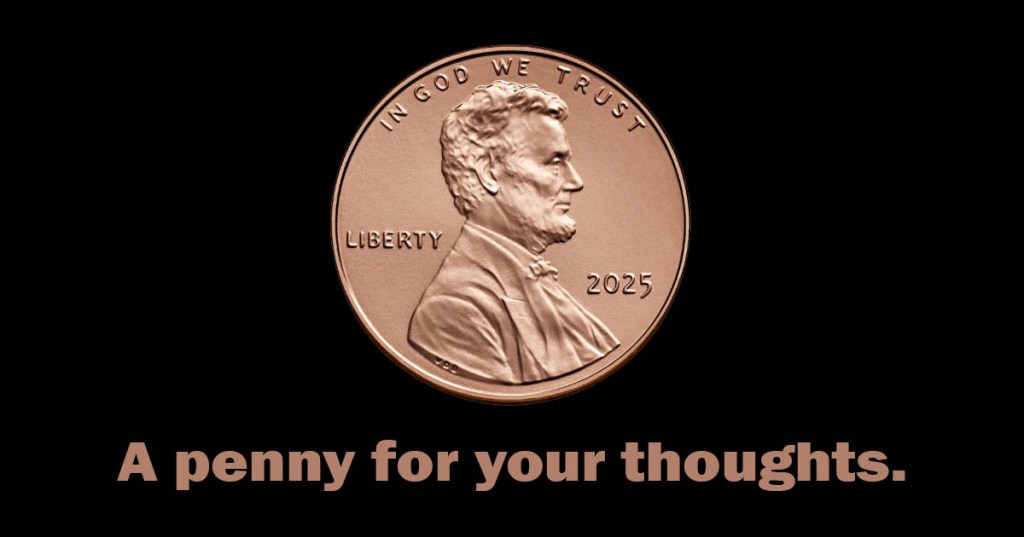
A penny for your thoughts.
This idiom may soon fade into our memories if, like many countries have already done, the U.S. discontinues its one-cent coin. So while this is still relevant, I will use it as an example of the value of critical thinking (spoiler alert: its value is beyond measure).
More and more studies report that critical thinking is on a steep decline. Some suggest that the pandemic caused people to focus on practical, survival thinking. Others point to increasing confidence in and use of artificial intelligence as the reason for decreased critical thinking. Whatever the cause, the effect of less critical thinking is stark, leading to poorer decision-making, polarization and intolerance, reduced academic and workplace performance, and erosion of ethical judgment, to name just a few of the most significant consequences.
Despite this drop, employers consistently cite critical thinking among the most highly sought after skills for employees, as noted in the World Economic Forum’s Future of Jobs Report and other sources. The good news for all of us is that critical thinking skills can be developed.
What exactly are these skills? I’ve amalgamated from a variety of researchers in this field a quick definition that suggests some of them – critical thinking: the process of differentiating between relevant and irrelevant information, objectively analyzing and evaluating data, looking at situations and issues from a variety of perspectives, and reflecting on our thought processes to identify assumptions and other barriers to effective decision-making.
To explore this, let’s turn back to the penny. Fun fact: it is actually the U.S. one-cent coin; the name “penny” is only a nickname derived long ago from the British “pence.” While mildly interesting, this likely falls in the category of “irrelevant” information as we think about the current state of this coin.
The idea of doing away with the penny is not new. Yet, for most Americans, the disposition of the penny wasn’t top of mind – that is until Super Bowl Sunday 2025 when the president posted on social media that he instructed the Treasury Secretary to stop producing new pennies.
The post was quickly picked up by other social media platforms and news outlets. When you first learned of this, what was your reaction? Did you think, “yes, finally, the penny has got to go”? Or were you thinking, “I kind of like the penny and would hate to see it go”? Whether you were on one side or the other or somewhere in between on this matter, what additional thought did you give it?
Some people quickly attacked the announcement, suggesting it was presidential overreach, since Article 1, Section 8 of the U.S. Constitution states, in part, “The Congress shall have power … to coin money [and] regulate the value thereof.”
Others supported the president, pointing to U.S. code that gives the Treasury Secretary the authority to mint and issue coins in the amount the Secretary deems necessary.
But, the U.S. Mint’s website says that Congress authorizes every coin and overseas the Mint’s operations.
Then, at the end of April 2025, Congress introduced bi-partisan legislation, the “Common Cents Act,” that called for the end of penny production. With both the president and Congress united on this, perhaps the question of authority regarding the penny was put to rest. Whew.
But wait, what else might need consideration surrounding the penny?
A Government Accountability Office report from 1996 (yes, nearly 30 years ago!), The Future of the Penny, pointed to several factors warranting analysis and evaluation, such as government costs, the fairness of rounding prices to the closest 5-cent increment, and public attitudes.
According to the U.S. Mint, in 2024 it cost 3.69 cents to make each 1 cent coin (penny). This certainly sounds wasteful, so this may be the driving factor in ending the penny – saving the government (and by extension, its citizens) money.
Without pennies, though, prices need to round up or down to the value of the next coin, the nickel (valued at 5 cents). It is likely that the rounding will almost all be up, adding one-to-four cents to the cost of items currently priced in cent increments not evenly divisible by five. Those small increases can add up quickly, especially for those with limited financial resources.
For those paying with cash, five-cent increments may increase the need for nickels. This is somewhat problematic for those citing cost savings as the reason to stop producing the penny, since it costs 13.78 cents to make each nickel (nearly 9 cents more than its value).
But people rarely use cash these days, right?
According to the Federal Reserve, in 2023, cash was the third-most-used payment method (at 16%) behind credit cards (32%) and debit cards (30%).
In what ways may your socio-economic status or age influence your perspective on the use of cash?
Again citing the Federal Reserve’s 2023 data, households with annual income less than $50,000 used cash for 28% of payments, compared to 13% for those with more than $50,000 in annual income. People over the age of 55 used cash for 22% of their purchases, compared to 12% for purchasers under the age of 55.
Today, there are approximately 114 billion pennies in circulation. Since younger people use cash less, perhaps ceasing penny production simply means that in the decades it will take to get the existing pennies out of circulation, the older people who prefer cash will be gone anyway. Maybe.
I don’t seek to persuade you in either direction about the fate of the penny. Frankly, if you are still with me this far into this post, you may be asking yourself why I am spending so much time on a coin that we casually throw into fountains and leave behind at cash registers for the next person. Of course, I am doing so in hopes of making a point.
Whether you are “Team Pennies-be-Gone” or “Team Pennies Forever”, I am encouraging you to think about the thinking behind your position. And, if you are saying, “I don’t really care,” what considerations have you given to why others might?
I will grant you that different issues warrant different levels of critical thought – and, perhaps for you, pennies need little thought. I also understand that with our busy schedules and overflowing workloads, the fear of “analysis paralysis” looms large, so we may feel we don’t have the time to think critically very often – and since people have been analyzing the end of the penny for decades, you may feel it is time to simply make a decision and move on.
Still, I thank you for pausing with me to think a little more deeply than usual about the penny. To improve your problem-solving, make better decisions, reduce assumptions and errors, and become more resilient against misinformation – for your benefit and the benefits of your friends, family, organizations, and communities – I urge you to make critical thinking a vital habit.

 Live Both And -- The Blog
Leave a comment