If you prefer to listen to this post, an audio version is available here…
Shaw communicates successfully how easily (and often!) communication, in all its forms, can fail. For the purposes of this short piece of static communication, we will focus on dynamic conversational communication.
Does this sound familiar? You leave a conversation thinking you and the other person are on the same page only to discover later, based on their actions, that it seems like you weren’t even in the same conversation.
What about this? You have had multiple conversations with someone about the same issue, yet the issue persists.
We talk – a lot – to each other, yet for all the words we put out, very few seem to get through in the meaningful ways we intend.
Why?
Communication misses its mark for a wide variety of reasons. To name just a few: distractions, experiences, mind sets, moods, perceptions, and power dynamics all complicate what we expect to be as simple as words sent, meaning received.
In addition to the missed meanings, poor communication can result in reduced trust, increased conflict, and a host of other negative, unintended consequences. To avoid these, practice key behaviors in your conversations.
The 4A Model of Communication™ provides a useful frame on which to build your skills and hone your behaviors.
ASK. We go into our conversations with something on our mind that we want to convey to the other person, so we often spend much of our time in “telling mode.” Shifting to “asking mode” increases the likelihood of more successful communication.
Because we know the thoughts, feelings, perspectives, etc. that we carry into the conversation, we can make assumptions about these for the other person, or worse, we don’t really think about the other person at all and instead focus solely on what we want from the conversation.
The only way to know what is happening for the other person is to ask. Of course, which questions and how you ask them have significant bearing on the effectiveness of the conversation. You can leverage specific behaviors (e.g. use open-ended questions, give time to answer, invite elaborations) to become adept at the “ASK” element of the model.
ATTEND. You receive verbal and non-verbal responses from the other person throughout a conversation, and you need to pay attention to these. More than simply listening to the words the person says (see below for the pitfalls we encounter in listening), attending to the person’s thoughts and emotions demonstrate that you see them as a full participant in the conversation and that their input matters just as much as yours.
Take a look at this continuum of listening…
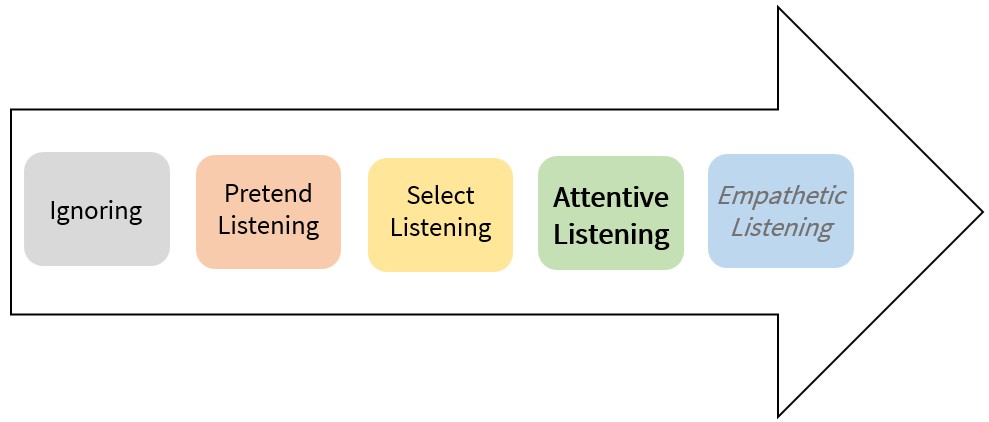
You have likely experienced people, at varying times, who listened to you in ways across this full continuum – and you have probably engaged in most of these types of listening yourself.
While Ignoring and Pretend Listening can be a little funny, you know these happen – sometimes unintentionally, sometimes not.
When we engage in Select Listening, we key in only on the things we want or have space to hear.
Attentive Listening, often what people mean by “active listening,” includes behaviors (e.g. engaged eye contact and posture, reflect/verbalize feelings, capture the core message) that allow you to truly attend to the other person. Aim here; your conversations will improve with the “ATTEND” element fully engaged.
The continuum goes even further with Empathetic Listening, requiring using your own feelings to tune in to another person’s view. This may be a stretch at times yet can enrich the overall experience and outcomes of the conversation.
ARTICULATE. Sharing your thoughts concisely and coherently involves both choosing the right words and presenting them clearly. Avoid ambiguity by focusing on the specifics of the idea, situation and/or actions, as well as explaining applicable impacts. Support your efforts to “ARTICULATE” by intentionally employing key behaviors (e.g. choose language and tone suited to the other person, use “I” messages, check for understanding).
AFFIRM. While engaging in casual chatting has its place, in the workplace, we generally expect our conversations to have a result – both parties agreeing to some path forward following the conversation. Rather than assuming (NOT the “A” word we want here) that the direction is understood, check with the other person. Seek their affirmation, and you give yours, that you are both on the same page as you leave the conversation.
Ask. Attend. Articulate. Affirm. As the model depicts, these elements intertwine as the conversation flows. Sometimes you may begin with articulating, other times with asking, and sometimes you need to lead with attending to the other person, holding your questions or information until later in the conversation.
And, before engaging in the conversation, consider a “bonus A” – Appropriate. Ensure appropriate time (when both people can focus and give the discussion adequate time), place (a comfortable location conducive to conversation), and adjustments to meet the other person where they are (e.g. language level and fluency, cultural norms, personality preferences).
Demonstrating the behaviors that underpin the 4A Model of Communication™ sets you and your conversations up for success. While the goal(s) of your communication influences its possible outcomes, you raise the probability of consistently achieving four particularly valuable ones by using the 4A Model. The other person will feel…
Heard – understood, acknowledged, and validated.
Respected – valued, honored, and treated with dignity.
Expanded – gained new information, insights or ways of thinking that broaden their understanding. (The cool thing here is that if you ATTEND well, you will be Expanded, too.)
Committed – dedicated, invested, willing to put in the effort/time to achieve/support something and see it through.
These important results can occur whether the conversation is in-person or online (or even over the phone). You can use similar behaviors in meetings, too.
You can modify the behaviors to apply during synchronous written communication (e.g. an active text chat), though with reduced effectiveness. It may feel faster and safer to shoot off a quick text or email, yet these can elevate the chances of misunderstandings and strained relationships.
Engaging in actual conversations – both short and long – in which you Ask, Attend, and Articulate can get you to your goals efficiently while reducing conflict, improving understanding, strengthening relationships, and increasing trust and transparency.
Speaking of transparency, even when using the 4A Model, not every conversation will produce sunshine and rainbows. Still, the meaningful results of confident conversations are worth the practice.

 Live Both And -- The Blog
Leave a comment